

 By
By Made up of 115 islands dotting the Indian Ocean off East Africa, Seychelles is known as a global hotspot for biodiversity. With as much as 85% of its animals and 45% of its plant species considered endemic, the archipelago is sometimes called the “Galapagos of the Indian Ocean”.
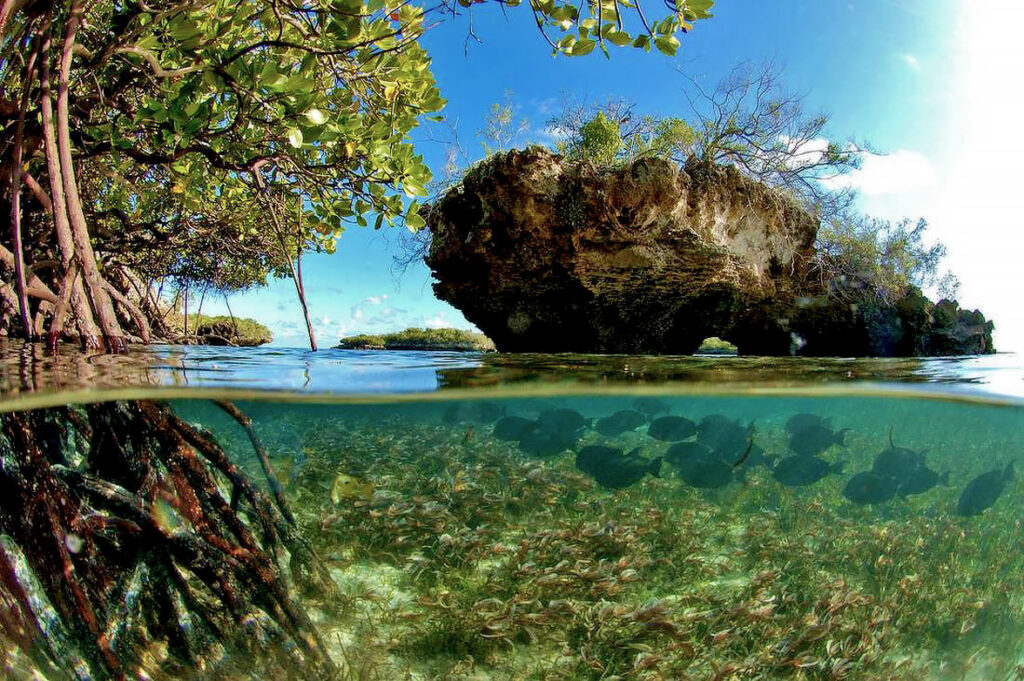
The Aldabra Atoll is located in the Indian Ocean, around 1,150 km (715 miles) away from Mahé (the largest island of Seychelles). Since 1982, the atoll has been a part of the UNESCO World Heritage List and is one of the two UNESCO World Heritage Sites in the Seychelles. Four large islands, Grand Terre, Malabar, Picard, and Polymnie, along with some smaller islands, belong to this large coral reef atoll, which surrounds a huge lagoon. The lagoon itself is between 100 and 34 km across, and 15 km wide, making it the second-largest raised coral atoll in the world, as well as a unique natural habitat.
The island group was given its name by the Arabic sailors who discovered the ‘Atoll al Chadra’ (the green island). The atoll was probably in a similar state 120,000 years ago to how it is now. The foundation on which the group lies is a volcano which extends 1 km deep into the ocean, formed millions of years ago after an eruption in the sea. The ring which nowadays is formed of different islands was originally the crater ridge of the volcano, once completely covered by the ocean, providing the ideal conditions for coral to grow. These days, the atoll is extremely flat, with its highest point just 8 meters above sea level.
The only residents of the atoll are a few researchers, carrying out work on behalf of the Seychelles Islands Foundation. Tourists may only visit the island as part of a cruise day trip and with permission.
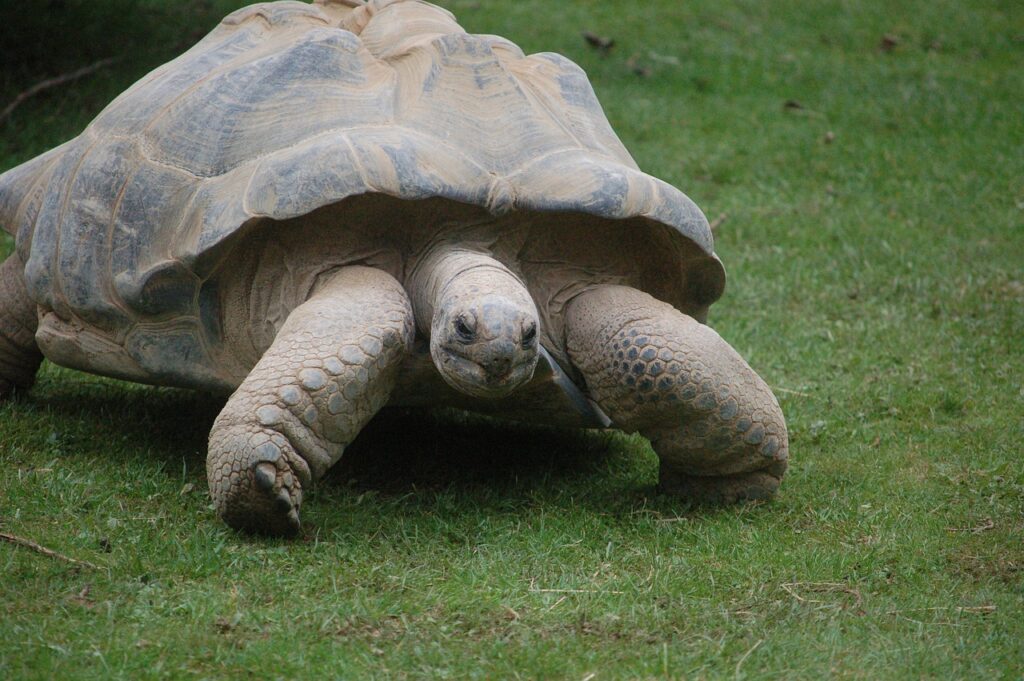
Due to the sparse vegetation and its isolated location, only relatively few humans have ever set foot on this piece of land. That said, engaged scientists and researchers, including Charles Darwin, made conscious efforts to prevent development on Aldabra, allowing the ecological systems on the island to thrive, including the largest colony of wild giant tortoises in the world. In total, there are around 150,000 individuals here, which is much more than the Galapagos Islands in South America, the other place in the world where the giant tortoise roams in the wild. Hawksbill turtles and green sea turtles, both of which live in the ocean, come to the beach to lay their eggs, where they likely encounter the tiny 60 cm coconut crabs.
Equally abundant on Aldabra are various bird species, including flamingos, herons, Aldabra white-throated crakes (which are unable to fly), tropical red-tail birds, sunbirds, ibises, sea-swallows, Aldabra dugong, and many other feathered creatures live and nest here, with 97 endemic species in total. Eight different species of mangroves live on the island, ensuring plenty of natural habitat for the birds. The flying fox is the only native mammal to the archipelago, while the Aldabra snail, once thought to have died out (in 1997), was re-discovered in 2014 during a survey. Besides shrubs and bushes, most of which are no more than three or four meters tall, there are 200 different flowering plants on Aldabra, of which 40 can only be found here. For a coral atoll, such a rich variety of plant life is exceptional. The rare mushroom coral can also be found here. In fact, the underwater world of Aldabra is also a unique paradise. Fishing here is banned, so many reef fish swim amongst bass, rays, skates, and mackerel.
Drift-diving through the channels in the atoll’s lagoon allows one to get up-close and personal with doctor fish, snappers, and mantas, as well as black-tip sharks, dolphins, and manatees.
Aldabra’s extreme remoteness and protection means that it is not open to mass tourism, however there are a few expeditions that operate and bring tourists to the atoll to experience the majestic lagoon, the incredible channel snorkeling, and of course the prehistoric island life.