
 By
Before you vote, see what your choices could mean.
We want to help you understand not just what's on the ballot, but what could happen afterward. Colorado Tradeoffs lets you test the choices, see the budget implications, and decide how you would respond.
Give it a try below. It takes less than 10 minutes.
On Thursday morning, November 12, 2026, the modern American workday quietly stalled. Across corporate towers in Manhattan, hospital wards in Houston, and municipal offices in Seattle, millions of employees opened their laptops only to be greeted by spinning loading wheels and frozen inboxes. Microsoft 365—the digital backbone of global commerce—had buckled.
At first, it felt like a routine technological hiccup, the kind of momentary digital weather we have learned to shrug off with a coffee break. Instead, it was the opening tremor of an extraordinary six-day cascade of systemic failures that laid bare just how fragile, overgrown, and precariously balanced America’s digital architecture has become.
Between November 12 and November 17, 2026, an unprecedented sequence of unrelated technical failures brought vital arteries of American life to a standstill. In rapid succession, Microsoft’s global communication suite went dark; the Federal Aviation Administration (FAA) ordered a nationwide ground stop that stranded tens of thousands of travelers; payroll giant Workday locked companies out of human resources systems; JPMorgan Chase froze banking and Zelle transfers for millions; United Airlines grounded departures over weight-and-balance software glitches; and, in a surreal Tuesday finale, both Apple’s consumer ecosystem and an internal classified network at the National Security Agency (NSA) suffered sudden degradations.
There were no explosions, no ransoms demanded on dark-web forums, and no foreign submarines severing undersea fiber-optic cables. In fact, the most unsettling revelation of the November 2026 outages is that nobody attacked America. We tripped over our own shoelaces—and nearly broke our neck.
A Domino Effect in Real Time
To understand the psychological whiplash of that week, you have to trace how swiftly the inconvenience curdled into national unease.
When Microsoft’s Outlook and Teams services faltered around 11:20 a.m. ET on November 12, the culprit was eventually traced to a latent software defect introduced months earlier in a July patch for networking gateway servers, compounded by traffic shifts and capacity bottlenecks. For roughly 24 hours, businesses across more than 70 countries operated in slow motion, reverting to phone calls and text messages. Even AI platforms like OpenAI’s ChatGPT experienced knock-on hiccups due to shared cloud dependencies.
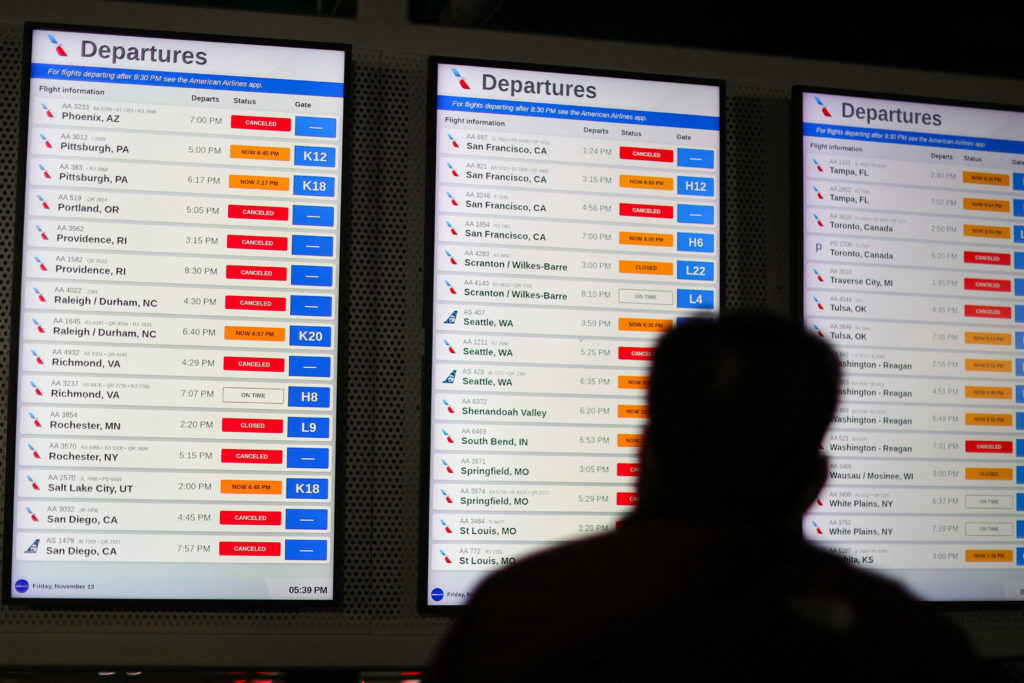
Before Microsoft had even cleared its backlog on Friday afternoon, November 13, the crisis leaped from the screen to the tarmac. At 3:54 p.m. ET, the FAA issued an emergency nationwide ground stop. Across the country, aircraft sat idling on taxiways from O’Hare to JFK while departure boards flashed red. Transatlantic flights from 42 European nations bound for the United States were temporarily halted.
The root cause was almost painfully mundane: during a modernization effort to replace decades-old copper wiring with fiber optics, a newly installed Juniper router at a radio transmitter site in Arkansas—alongside a second node in Texas—malfunctioned, flooding the FAA’s legacy telecommunications network with more than 1,000 connection attempts every few seconds. Outdated air traffic control switches choked on the data storm, forcing regulators to halt departures for four hours and 25 minutes to guarantee mid-air safety. That same Friday night, Workday suffered a separate failure after a disaster-recovery test inadvertently collided with production databases, leaving thousands of firms unable to process payroll or timekeeping into Saturday.
By Monday, November 16, anxiety had crept into household wallets. Millions of JPMorgan Chase customers woke up to delayed transactions and stalled Zelle payments—creating ripple effects across Bank of America, Wells Fargo, and U.S. Bank—after a software bug struck an on-premise hardware system. Hours later, United Airlines briefly halted departures when crew-facing flight-planning and weight-and-balance tools went offline. And on Tuesday, November 17, an internal Apple software update scrambled iCloud authentication, locking users out of Apple Pay, the App Store, and Apple Music, on the exact same day routine maintenance degraded an internal NSA communications network.
The Phantom of “Cyber Pearl Harbor”
Amid heightened geopolitical tensions abroad—including ongoing cyber advisories regarding state-backed actors from Iran and China—rumors of a coordinated digital assault spread across social media faster than engineers could reboot their servers. For a few tense hours on Friday and Monday, Americans wondered if they were witnessing the opening salvo of the long-feared “cyber Pearl Harbor”.
Senior intelligence and security officials moved quickly to douse the panic. Director of National Intelligence Jay Clayton stated unequivocally that the disruptions were neither a cyberattack nor a coordinated nation-state campaign. Department of Homeland Security Secretary Markwayne Mullin echoed that assessment, noting with near-total certainty that malicious hackers were not behind the failures.
Yet, as cybersecurity executives and systems engineers pointed out, the absence of a foreign adversary is hardly comforting. If anything, it exposes a more insidious vulnerability. An external attacker can be deterred, sanctioned, or defended against at the perimeter. You cannot sanction a faulty software update, and you cannot build a firewall against your own architectural debt.
Legacy Code Meets Hyperscale Ambition
Strip away the corporate jargon from the post-mortem reports, and two structural fault lines emerge at the heart of America’s digital fragility.
First is the collision between cutting-edge software and aging physical plumbing. Much of America’s critical infrastructure—from air traffic control centers to core banking mainframes—runs on decades-old hardware and legacy code never designed for the relentless, hyper-connected traffic of 2026. As DHS Secretary Mullin observed during the crisis, layering modern, high-speed digital tools onto antiquated foundations places immense strain on systems near their processing limits. When a modern router speaks too fast to a 30-year-old telecommunications switch, the result is digital gridlock.
Second is the tyranny of automation and hyperscale concentration. Over the past decade, American enterprises and government agencies have consolidated onto a handful of colossal cloud and software providers. That centralization delivers remarkable efficiency on normal days, but it creates single points of catastrophic failure. Worse, modern networks rely on automated deployment pipelines and self-healing scripts that operate at machine speed. When a routine configuration change contains a hidden flaw, automation ensures that the mistake propagates across continents in milliseconds—long before a human engineer can pull the emergency brake.
What It Portends for the Future
The November 2026 outages did not cause permanent physical destruction, and markets largely shrugged off the losses within days. But treating this week as a mere statistical coincidence would be a grave mistake. It is a preview of the defining infrastructural challenge of the coming decade.
The Death of “Set-It-and-Forget-It” Cloud Reliance
For years, corporate boards treated migrating to major cloud vendors as the ultimate risk-reduction strategy. Going forward, single-vendor dependency will be viewed as a fiduciary liability. Expect a surge in “multi-cloud” redundancy, stricter regulatory scrutiny of systemic tech providers, and a revival of analog, offline fallback protocols for hospitals, airlines, and financial institutions.
An Urgent Reckoning Over Infrastructure Modernization
Just as crumbling bridges forced America to confront physical infrastructure decay, the FAA ground stop has turned invisible code and copper wires into a front-page political issue. Modernizing federal and financial legacy systems cannot be done piecemeal on shoestring budgets without risking mid-upgrade collisions. Congress and corporate leaders face mounting pressure to fund deep, ground-up replacements—not merely digital duct tape.
A Roadmap for Future Adversaries
Perhaps the sharpest warning is strategic. Nation-state adversaries did not trigger the November 2026 chaos, but they were undoubtedly taking notes. By watching how a single misconfigured router in Arkansas could ripple into transatlantic flight cancellations, or how a localized banking bug could stall peer-to-peer payments nationwide, foreign intelligence services just received a free, real-time stress test of America’s weakest chokepoints.
Living in the Age of Digital Weather
We have spent the twenty-first century building a civilization suspended in the cloud—frictionless, instantaneous, and astonishingly convenient. We stopped carrying cash because Apple Pay and Zelle always worked. We stopped printing boarding passes and patient charts because the server was always reachable.
The lesson of November 2026 is not that technology is failing us, but that we have outgrown our margin for error. Until America fortifies the aging foundations beneath its gleaming digital skyline, outages will no longer feel like rare emergencies. They will become a new kind of weather—sudden, sweeping storms that remind us, every so often, just how close to the ground the cloud really is.