
 By
Before you vote, see what your choices could mean.
We want to help you understand not just what's on the ballot, but what could happen afterward. Colorado Tradeoffs lets you test the choices, see the budget implications, and decide how you would respond.
Give it a try below. It takes less than 10 minutes.
Across the wind-swept Eastern Plains, through the bustling corridors of the Front Range, and high into the high-alpine valleys of the Rocky Mountains, the ballot box has quietly become Colorado’s most influential classroom.
As state legislators routinely wrestle with budget constraints, mandatory formulas, and decades of fiscal tug-of-war, local school districts have increasingly bypassed the State Capitol altogether.
Instead, they are taking their survival, expansion, and everyday operational needs straight to the people who know their schools best: local property owners.
Yet as ballot counts settle and communities process the outcome of local tax measures, one truth emerges with striking clarity: Colorado is a patchwork of deeply divergent education priorities. In some communities, voters consistently open their pocketbooks to fund modern STEM labs, expanded art programs, and competitive teacher pay. In others, escalating property tax friction and deep-seated ideological fractures have created a firm ceiling on local taxation, forcing administrators to make agonizing cuts.
To understand how school tax measures have fared in Colorado is to trace the economic fault lines of the Centennial State—a story where local voters wield immense power over the educational opportunities of the next generation.
The Engine of Local Revenue: Bonds vs. Overrides
To grasp why school tax votes generate such fierce local passion, one must first look under the hood of Colorado’s school finance structure.
Bound by the constraints of the state’s historic Taxpayer’s Bill of Rights (TABOR)—which limits government revenue growth and mandates voter approval for any tax increase—districts cannot simply raise local property taxes to cover budget shortfalls. Instead, superintendents and school boards rely primarily on two key ballot mechanisms:
- Bond Questions (Capital Outlay): Think of bonds as a district’s mortgage. Bonds allow districts to borrow upfront capital to construct new buildings, renovate aging infrastructure, upgrade HVAC systems, or bolster campus physical security. By law, bond dollars cannot be used for operational costs like teacher salaries or classroom supplies.
- Mill Levy Overrides (Operational Funds): Often referred to as MLOs, these local property tax increases fund daily operations. They cover everything from retention bonuses to keep teachers from leaving high-cost areas, to special education staffing, mental health counselors, and specialized career-technical courses.
Because state-level formulas establish a baseline funding floor across Colorado’s 178 school districts, local MLOs and bonds serve as the primary levers for communities to differentiate themselves. The result? Wealthier or more tax-tolerant communities can stack local overrides on top of state funding, while cash-strapped or tax-averse districts remain anchored strictly to state minimums.
A Tale of Two Front Ranges: Urban Triumph vs. Suburban Resistance
Nowhere is the dynamic of voter sentiment more starkly illustrated than along Colorado’s Front Range urban corridor.
In Denver, voters have maintained a decades-long streak of supporting public education tax measures. When Denver Public Schools approached voters with Ballot Issue 4A—asking for a $44 million annual mill levy override—the electorate overwhelmingly approved the measure.
Over 68 percent of Denver voters signaled a willingness to absorb higher property tax rates on median home values to secure classroom funding.
The primary driver for Denver voters wasn’t shiny new sports facilities; it was human capital. Over half of the approved $44 million will go directly toward increasing competitive compensation for teachers and support staff, helping slow the burn of educator turnover in an increasingly expensive city. State mandate rules also mean local charter schools receive their proportional slice, unifying public school families behind a shared investment.
Just 30 miles to the south, however, the political climate tells a drastically different story.
In Douglas County, where suburban sprawl meets suburban conservatism, the Douglas County School District pitched a $54 million mill levy override. The district framed the revenue as an urgent necessity to prevent an exodus of experienced educators to neighboring districts that pay significantly higher base salaries.
Yet, when the final tallies rolled in, Douglas County voters handed the measure a decisive defeat, with nearly 55 percent voting “No”.
Why the sharp split between neighboring counties?
Property Tax Fatigue: Following record-high statewide property assessments in recent years, homeowners in suburban districts hit a wall of economic exhaustion. Even modest tax additions faced heavy blowback at the ballot box.
Board Governance and Trust: Voter appetite for tax increases is closely tied to public trust in local school boards. In districts plagued by political infighting, curriculum battles, or public governance controversies, voters frequently express their discontent by withholding financial support.
Demographic Shifts: Communities with higher concentrations of retirees or households without school-aged children are statistically far more resistant to property tax increases than neighborhoods surging with young families.
Rural Realities: Funding Struggles on the Eastern Plains and Beyond
While large suburban districts navigate political crosscurrents, Colorado’s small, rural school districts face an entirely different set of stakes.
For rural superintendents, a failed mill levy override isn’t just about delaying a hardware upgrade—it often determines whether a school can keep its doors open five days a week or retain a single physics teacher.
Take rural El Paso and Teller counties, for example. In Hanover School District 28, a staggering 75 percent of voters soundly rejected four proposed mills aimed at stabilizing staff salaries. Over in Woodland Park, a quarter-cent sales tax measure intended to prop up district operations withered under a 67-to-33 percent defeat.
In agricultural and mountain communities where the commercial tax base is small, the financial burden of a school bond or MLO falls almost exclusively on local agricultural land or residential property owners. When commodity prices fluctuate or land values drop, voters become deeply reluctant to lock themselves into permanent property tax commitments.
Yet, rural communities are far from monolithic. In regions where districts have successfully positioned their schools as the socio-economic anchor of the entire town—serving as community centers, athletic hubs, and major local employers—tax measures regularly beat the odds. Success in these towns requires hyper-local grassroots campaigns: face-to-face town halls, kitchen-table conversations, and hyper-transparent breakdowns showing exactly what a $5-a-month tax increase will yield for local children.
The Statewide Safety Net: Statewide Ballot Relief
While local districts fight their individual battles on the municipal ballot, statewide measures offer an intriguing macro-picture of Colorado’s educational funding landscape.
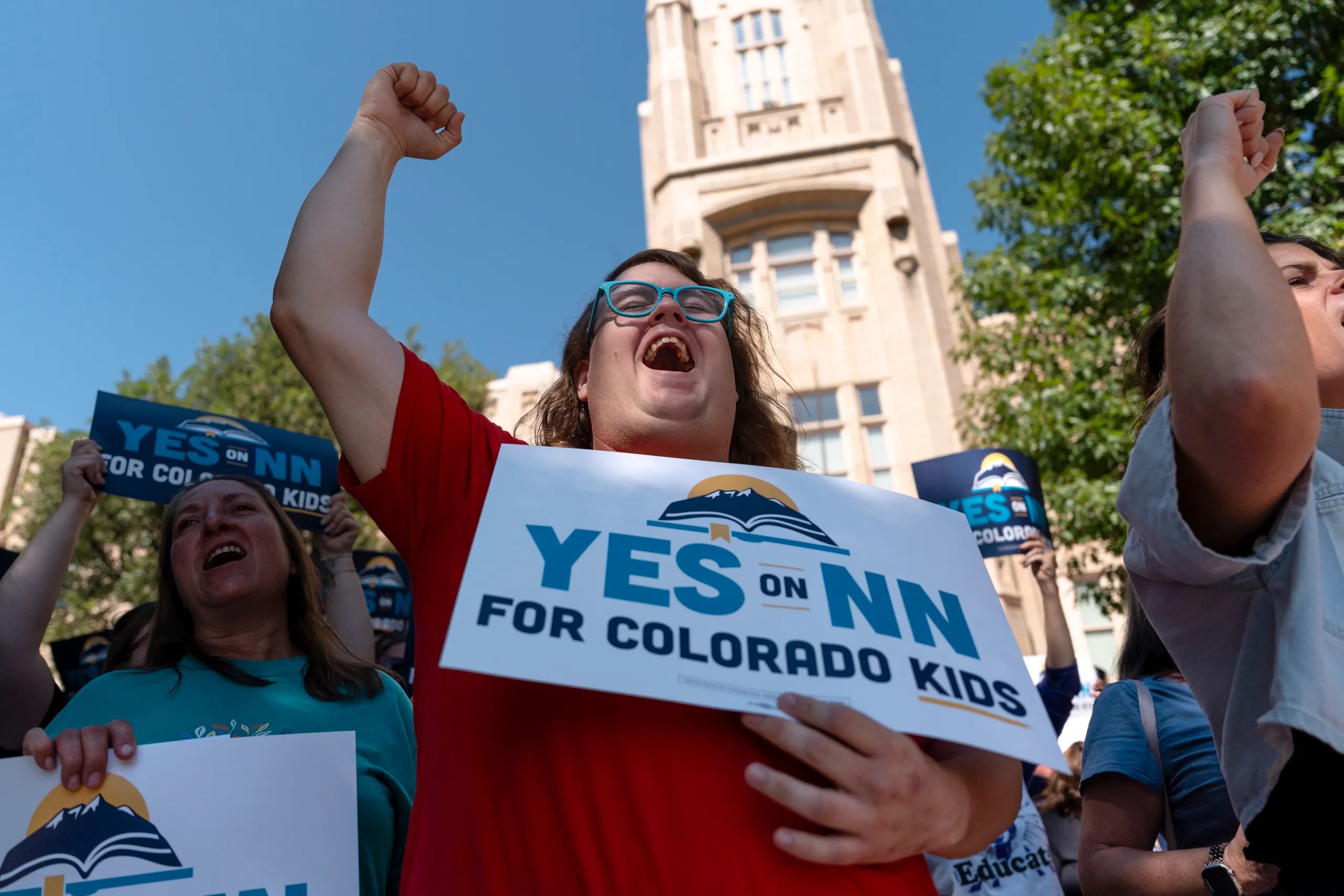
The statewide passage of Proposition NN highlights a key paradox in Colorado voter behavior. Proposition NN asked Coloradans to allow the state to retain surplus revenue—otherwise slated to be refunded under TABOR formulas—and redirect those billions directly into public K-12 education, teacher retention, and early childhood programs.
| Statewide Measure | Focus Area | Voter Verdict | Primary Impact |
|---|---|---|---|
| Proposition NN | TABOR Refund Retention | Approved | Redirects surplus revenue to K-12 funding, teacher pay, and class size reductions. |
| Local MLOs (Statewide Avg) | Operating Budgets | ~60% Pass Rate | Mixed outcomes depending heavily on district trust and local demographics. |
The passage of Proposition NN demonstrates that Coloradans broadly recognize the systemic underfunding of their K-12 schools, which has lagged behind national averages for years. However, the willingness to vote “Yes” at a statewide, non-direct level frequently fractures when voters are asked to add specific line items to their personal, local property tax bills.
Key Ingredients of Successful School Tax Campaigns
An analysis of school tax election results across Colorado reveals a clear pattern distinguishing successful campaigns from failed ones:
Laser-Focused Transparency: District voters no longer accept generic “for the kids” pitch decks. Winning campaigns produce granular breakdowns—down to the specific building, classroom, and salary scale—showing exactly where every dollar goes.
Sunset Clauses: Taxpayers are significantly more willing to approve mill levy overrides that include sunset provisions (e.g., expiring after 7 to 10 years) rather than open-ended, permanent tax hikes.
Community-Led Co-Design: Successful districts spend 12 to 18 months before putting a measure on the ballot assembling citizen oversight committees, polling residents, and adjusting ballot language based on public feedback. When voters feel a measure was built with them rather than imposed on them, approval rates surge.
The Road Ahead for Colorado Classrooms
The legacy of Colorado’s school tax measures is a tale of two realities.
In districts where tax measures pass, classrooms are bolstered by new technology, competitive salary scales, and modernized facilities. In districts where voters say no, administrators face immediate, painful choices: scaling back course offerings, freezing salaries, increasing class sizes, or consolidating schools altogether.
As Colorado continues to grapple with housing affordability, tax reform, and population shifts, local ballot measures will remain the primary arena where the future of public education is decided. One thing is certain: as long as local property owners hold the ultimate power over the school budget, the most important school board meeting in Colorado will always take place inside the voting booth.