
 By
Before you vote, see what your choices could mean.
We want to help you understand not just what's on the ballot, but what could happen afterward. Colorado Tradeoffs lets you test the choices, see the budget implications, and decide how you would respond.
Give it a try below. It takes less than 10 minutes.
On any given Saturday along East Colfax Avenue in Aurora, just east of Denver’s gleaming downtown skyline, the air carries the unmistakable warmth of home—thousands of miles from where many of its residents were born. Inside bustling family-owned markets and neighborhood kitchens, the sharp, earthy aroma of berbere spice mingles with simmering peanut stew, freshly baked injera, and the crisp percussion of West African Afrobeats spilling onto the sidewalk.
For decades, Colorado’s public image was defined almost exclusively by alpine peaks, ski resorts, and a predominantly white demographic profile. Yet beneath the shadow of the Front Range, one of the most dynamic demographic transformations in the American West has been quietly taking shape. Driven by waves of economic migrants, international students, professionals, and refugees fleeing conflict in the Horn of Africa, the Great Lakes region, and West Africa, Colorado’s African immigrant population has grown into a vital cultural and economic force.
To live as an African immigrant in the Centennial State, however, is to navigate a daily paradox: building a life in one of the nation’s fastest-growing, opportunity-rich economies while confronting structural barriers that frequently render newcomers invisible. Through grit, mutual aid, and entrepreneurial ingenuity, Colorado’s African diaspora is not merely surviving—it is steadily reshaping the state’s civic landscape and laying the groundwork to become a transformative force for good.
The Architecture of Survival: Navigating Invisible Barriers
Arriving in Colorado from Lagos, Addis Ababa, Dakar, Mogadishu, or Kinshasa often begins with a jarring adjustment—not merely to the thin mountain air and sub-zero winter mornings, but to an intricate maze of economic and social hurdles.
For many newcomers, the first shock is credential devaluation. Across the Denver metropolitan area, trained physicians, civil engineers, accountants, and educators from African universities routinely find their degrees discounted or unrecognized by American licensing boards. Forced to start over to pay rent in one of the country’s most expensive housing markets, highly skilled professionals frequently take survival jobs—driving rideshares through snowstorms, working overnight shifts in warehouses, or staffing elder-care facilities—while spending years and thousands of dollars attempting to recertify.
Housing affordability compounds that strain. As rents and home prices across Denver, Aurora, and Colorado Springs surged over the past decade, large multi-generational African families—for whom extended kinship networks are a cornerstone of daily life—have struggled to find adequately sized, affordable housing. In neighborhoods like East Colfax and Montbello, rising living costs have pushed working-class immigrant households to the financial brink, forcing many breadwinners to juggle two or even three jobs.
Beyond economics lies a quieter, more personal battle: cultural isolation and mental health. African immigrants occupy a complex space in America’s racial landscape, often experiencing discrimination as Black residents while simultaneously feeling estranged from broader mainstream institutions that overlook the vast linguistic, religious, and cultural diversity spanning 54 African nations. Meanwhile, refugees resettled in Denver from conflict zones in the Democratic Republic of the Congo, Eritrea, Somalia, and Sudan carry deep, unspoken trauma—yet cultural stigma around therapy and a severe shortage of culturally competent, multilingual mental health providers leave many families to carry that weight alone.
In response, survival has become a collective art form. Across the Front Range, informal safety nets—rotating savings clubs known as susu or ekub, church and mosque mutual-aid funds, and auntie-led childcare networks—step in where formal systems fall short. When a family faces a medical emergency, a tuition bill, or a funeral back home, community members pool resources within hours, proving that solidarity remains their most reliable currency.
Triumphs Written in Enterprise, Advocacy, and Culture
Despite steep structural headwinds, the story of Africans in Colorado is increasingly defined not by hardship, but by remarkable resilience and upward mobility.
Entrepreneurship has emerged as one of the community’s sharpest engines of triumph. Along the Aurora Cultural Arts District and throughout Denver’s commercial corridors, African-owned businesses have transformed once-overlooked storefronts into thriving economic hubs. Ethiopian and Eritrean restaurants have become beloved culinary staples across the metro area, drawing diners from every background. Nigerian, Ghanaian, Senegalese, and Somali entrepreneurs have launched logistics firms, home-healthcare agencies, tech consultancies, tailoring ateliers, and international grocery stores that anchor neighborhood economies.
Equally transformative has been the rise of homegrown civic institutions built by and for the diaspora. Organizations such as the African Leadership Group (ALG), founded in Aurora by Senegalese immigrant Papa Dia, have turned grassroots frustration into political and economic clout. What began as a modest gathering to help newcomers navigate local systems has evolved into a powerhouse nonprofit offering public-speaking cohorts, financial literacy workshops, homeownership clinics, and youth mentorship. Similarly, the African Community Center (ACC) in Denver has helped thousands of refugees rebuild self-sufficient lives, pairing newly arrived families with job training, English classes, and micro-enterprise support while employing staff who speak nearly 30 languages.
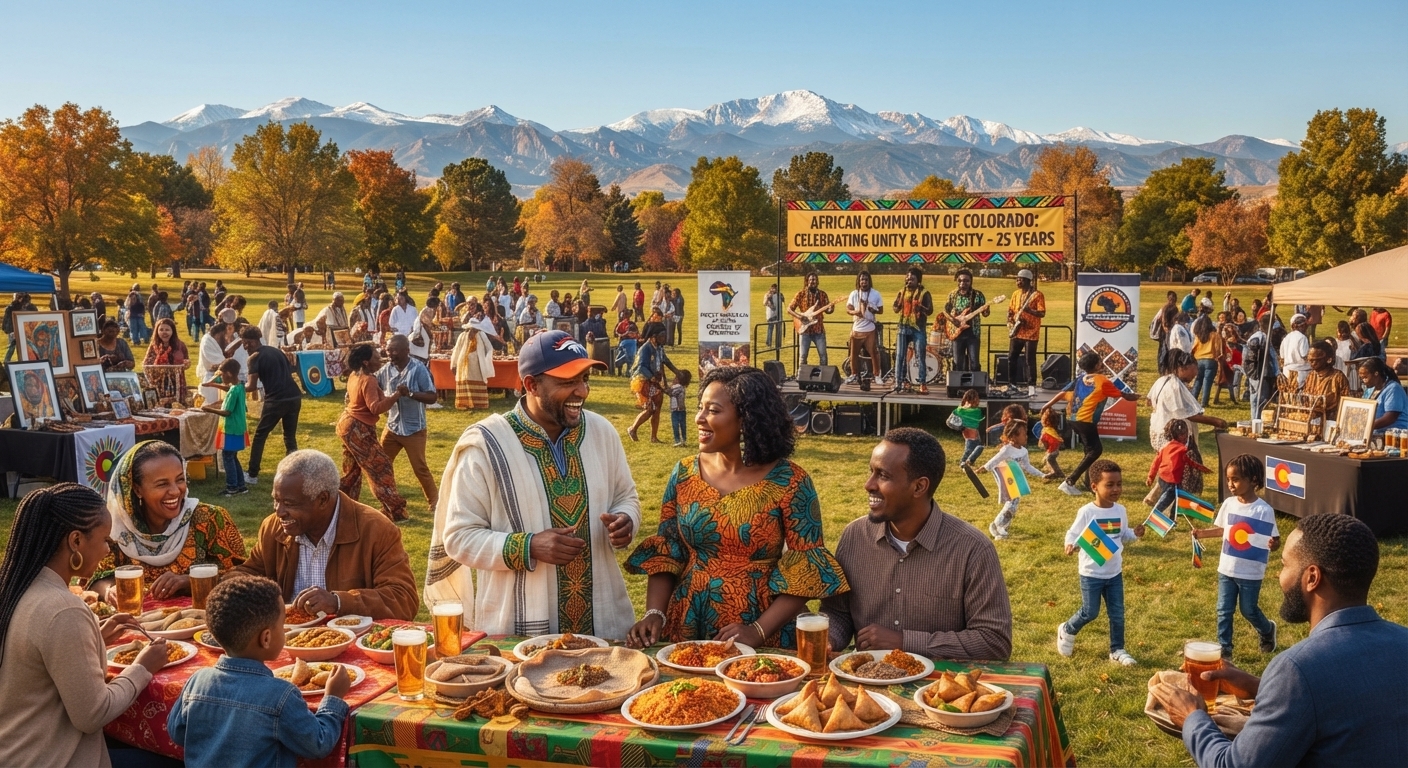
Meanwhile, a second generation—raised in Colorado classrooms while steeped in African heritage at home—is breaking barriers across the state. Children of African immigrants are graduating at high rates from the University of Colorado, Colorado State University, and Metropolitan State University of Denver, stepping into leadership roles in aerospace, clean energy, medicine, law, and municipal government. Every summer, events like the annual Afrik Impact gala and vibrant cultural festivals in Aurora and Denver draw thousands of residents, turning African music, fashion, and storytelling into celebrated fixtures of Colorado’s civic calendar.
A Force for Good: Blueprint for the Future
Today, Colorado’s African community stands at an inflection point. Having established a durable foothold, its leaders and young professionals are looking beyond self-preservation toward a broader question: How can the African diaspora serve as a decisive force for good across Colorado—and back on the African continent?
The answer lies in three converging frontiers:
Bridging Local Workforce Gaps and Civic Leadership. Colorado faces acute labor shortages in healthcare, engineering, early childhood education, and skilled trades. By partnering with state lawmakers, community colleges, and licensing boards to streamline foreign-credential recognition and expand apprenticeship pipelines, African community organizations can unlock thousands of underutilized professionals—strengthening Colorado’s hospitals, classrooms, and infrastructure while lifting immigrant households into the middle class. At the ballot box and on local school boards, city councils, and state commissions, greater African representation promises policies grounded in lived global perspective and equity.
Catalyzing Transatlantic Trade and Innovation. Colorado is a national hub for renewable energy, agritech, aerospace, and digital innovation—precisely the sectors driving rapid transformation across Africa’s fastest-growing economies. Armed with bilingual fluency, cultural literacy, and deep professional networks on both continents, African Coloradans are uniquely positioned to act as trade ambassadors and tech founders. Through diaspora-led business incubators and investment syndicates, Colorado entrepreneurs can channel clean-water technology, solar microgrids, and venture capital to African startups, creating bilateral prosperity that benefits Denver and Nairobi alike.
Healing Divides Through Radical Hospitality. Perhaps the community’s most profound gift to Colorado is social. In an era of deepening political polarization and urban isolation, African cultural traditions—rooted in Ubuntu, the philosophy that “I am because we are”—offer a powerful antidote. From urban community gardens in Aurora that bring together refugees and longtime Colorado neighbors, to cross-cultural mentorship programs uniting African immigrants and African American communities, diaspora leaders are modeling what a genuine, inclusive community looks like in practice.
Looking Toward the Peaks
Late on a Sunday afternoon in Aurora, inside a brightly lit community hall, a dozen newly arrived immigrants stand at a podium practicing public speaking—finding their voices in a second or third language while neighbors applaud every breakthrough. Outside, the sun dips behind the snow-dusted silhouette of the Rocky Mountains, casting long golden light across the plains.
For generations, people have come to Colorado drawn by the promise of wide horizons and a fresh start. Today, the sons and daughters of Africa are fulfilling that promise in their own unmistakable cadence—proving that when newcomers are given room to root and rise, they do not merely adapt to the place they call home. They make it stronger, wiser, and immeasurably richer for everyone.