
 By
By Health authorities have confirmed more than 300 cases of the virus in the two countries and are investigating 1,500 more possible infections.
Over 40 people have died in a growing Ebola outbreak in the Democratic Republic of the Congo and Uganda, where government and international aid organizations are struggling to cope with the spread of the disease.
The current strain of Ebola, the Bundibugyo virus, is “a severe and often fatal form” of the disease, according to the World Health Organization. It has no approved treatment or vaccine.
The World Health Organization and the Africa Centers for Disease Control and Prevention both reported 43 confirmed deaths across the countries as of Saturday, including 42 in Congo and one in Uganda, according to the WHO. However, 349 people are suspected to have died from the virus in Congo and Uganda.
There are 272 confirmed cases of the disease in both countries, with 263 in Congo and nine in Uganda, the WHO reported. The Africa CDC has reported a total of 263 confirmed cases across Congo and Uganda, with more than 1,100 suspected cases still under investigation.
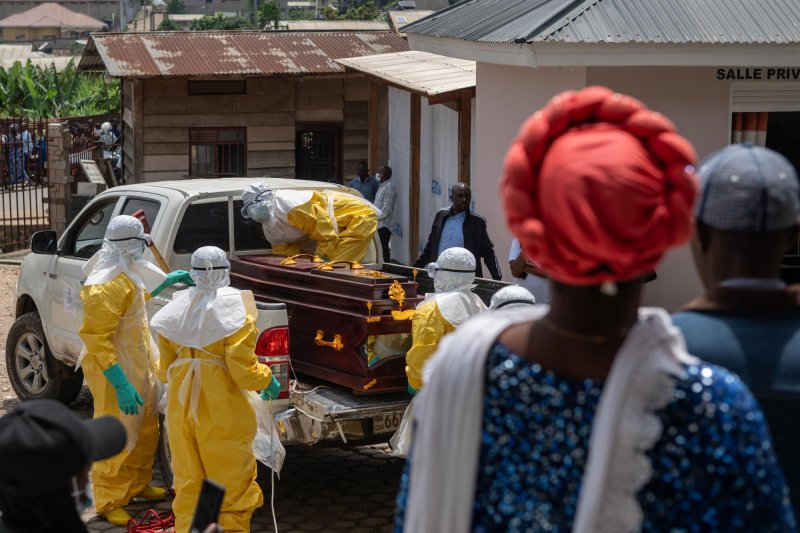
The source of the virus is believed to be the fruit bat, and human infection can occur through contact with secretions from infected wildlife, according to the WHO. It then spreads from person to person through the same method, and can be amplified by burial practices that involve contact with the deceased and inadequate infection prevention and control in healthcare settings.
Doctors Without Borders is one of the organizations helping respond to the outbreak in Congo’s Ituri province. Deputy Director Alan Gonzalez said the team is playing catch-up with the disease.
“The virus is spreading faster than we’ve been able to respond,” Gonzalez told newsmen, adding that “correct testing” is key.
“It’s really difficult to know who is positive, who has the virus, who doesn’t. And then it’s harder to do contact tracing,” he said.
Gonzalez said the outbreak has the potential to become even worse due to the “perfect storm” of a delay in identifying the Bundibugyo strain and its quick spread.
On Saturday, WHO Director-General Tedros Adhanom Ghebreyesus visited the city of Bunia in Congo, the epicenter of the outbreak in the country’s Ituri province. Tedros advised against unsafe burial practices and urged countries to reconsider travel bans and border closures, saying they “discourage transparency.”
Tedros said that five patients in Bunia had recovered from the disease. He spoke about the patients’ good prognosis during the opening of a new Ebola treatment center in the city.
“Of course we’re still working on vaccines and treatments, but that doesn’t mean that people cannot recover from Ebola,” he said.
Congo has had multiple Ebola outbreaks — this one is its 17th. Tedros said Saturday that the country has always been able to end each outbreak.
How 2026 Ebola cases compare to past outbreaks
Cases in the Democratic Republic of the Congo have surged since the WHO’s May 17 emergency declaration, with more than 1,000 suspected cases are under investigation across the region.
How contagious is Ebola virus?
Every virus has an R₀ factor (or reproduction number), which estimates the number of individuals one infected person is likely to infect others in the absence of interventions such as vaccination and infection control.
Compared to other infectious diseases, Ebola has a relatively low reproduction number compared to COVID-19 or measles, but it has a much higher fatality rate.