

 By
By 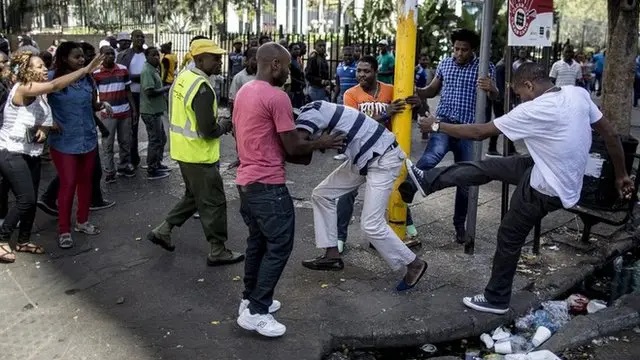
Just recently, South African nationals were once again in the news for the wrong reasons. Bitten by the bugs of xenophobia, they reportedly turned against foreigners, including Nigerians, whose government fought hammer and tongs to liberate the territory from the obnoxious apartheid subjugation. Their grouses are that foreigners have cornered jobs and opportunities meant for them alone.
According to reports, the Operation Dudula Movement orchestrated the renewed wave of anti-immigrant sentiment that led to tensions and violent protests. Protesters marched, demanding the removal of illegal immigrants, with reports of shops being looted and businesses hurriedly closing down in anticipation of violence.
The resurgence of the attacks is consistent with a long-term pattern of xenophobic violence in South Africa, which has persisted since 2015. The situation has caused significant concern, with Nigerian officials in South Africa often calling for the protection of their citizens and the investigation of incidents by South African authorities.
Statistics have shown that South Africa is home to about four million documented foreign nationals. Most of these migrants come from neighbouring African countries, especially within the Southern African Development Community (SADC).
A breakdown of the dominant migrants shows Zimbabwe accounting for about 1,010,000 people (45%); Mozambique – 416,500 people (18%); Lesotho – 227,700 people (10%); Malawi -198,800 people (8%); the United Kingdom – 61,000 people (2 to 3%); and the Democratic Republic of Congo – 10,000. Tanzania, Zambia, Namibia, and some migrants from other parts of the world, like Asia, Europe, and Latin America, are smaller in number. Nigeria is the only far-flung country with about 400,000 people.
Nigerian nationals resident in that country have endured maltreatment at the hands of their hosts for decades since freedom was restored to the enclave with the active participation of the Nigerian government. Besides being sucked in as a member of the Frontline States during the agitation for freedom, Nigeria, at one point, levied its citizens to raise funds to prosecute the struggle.
Despite the support South Africa received from Nigeria during its darkest hours, South Africans are still fixated on their benefactors. At the slightest opportunity, they come down on them heavily and with venom. The average South African is still living in the past, even decades after the liberation. This is understandable. Having endured the torment by the white supremacists for decades, they see non-natives as the reincarnation of their oppressors. For a people that have been used to resistance and violence, it would take a sustained re-orientation effort(s) to appreciate and cohabit peacefully with non-nationals in a post-apartheid dispensation.
Many factors are responsible for the legal or illegal migration of Nigerians to South Africa and other parts of the globe, a practice now famously referred to as Japa. Chief among them is bad governance that collapses the economy, leading to unemployment and allied hardships. Tempted by the greener pastures, Nigerians troop out in droves, with many of them carrying no valid documents. Those ones are arrested and hurled into jail.
Another factor fueling the bad blood in recent times is Nigerians’ penchant to import their traditions and cultures without any regard for the sensitivity of their hosts. Just a few days ago, some indigenes in the Eastern Cape Province in South Africa kicked against the alleged coronation of a Nigerian “Igbo King” in KuGompo City. The natives termed it a violation of the country’s sovereignty and traditional leadership structures that triggered violent protests, leading to wanton destruction of properties and massive looting of shops. The South African Deputy Minister of Traditional Affairs, Prince Zolile Burns-Ncamashe, followed up with a warning against violating the country’s traditional leadership laws.
A few months ago, the traditional installation of a Nigerian Igbo ruler also drew a backlash from the Ghanaian locals, who called for the immediate disbandment of the illegal institution and threatened to take further action if the government did not intervene. It was reported that a planned 50-acre “Igbo Kingdom” or “Igbo Village” in the Old Ningo area of Ghana had been carved out, which would include markets, schools, and a palace. This led to the accusations that Igbo leaders were attempting to build a sovereign state within Ghana and called for the expulsion of Nigerians from their soil.
Migration is an inevitable exercise. However, it is pertinent that the Nigerians in the Diaspora Commission (NIDCOM) need to educate our citizens on the need to respect the cultures and traditions of their host nations and avoid any conflicts that could lead to the ugly situations like those witnessed in South Africa and Ghana. Governments at all levels should also engender good governance as a deliberate attempt to discourage Nigerians from seeing Japa as the first choice in the face of adversities.